|
The Great Migration
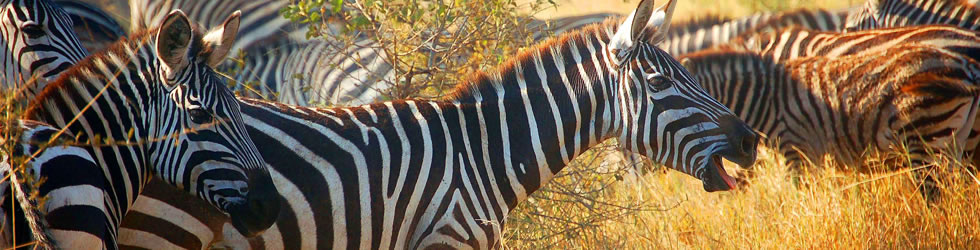
Each year, nearly 2 million animals move through Tanzania and Kenya driven
by seasonal rain and drought in what is known as the Great Migration. One
million wildebeest and 200,000 zebras make up the largest populations of the
migrating herds, followed by gazelles. Though the timing of the annual
migration varies from year to year and cannot be predicted with any certainty,
we've outlined the general locations and movement patterns of the animals
throughout the year below.
Important Note: This is a general description of the migration pattern.
The exact timing of the Great Migration cannot be predicted, as it depends on
each year's rainy season and other variable factors.
cannot be held responsible for seasonal changes
that cause the migration to vary from this description.
December to April: These months find wildebeest and zebra herds scattered
across the plains of the southern Serengeti and the northern Ngorongoro Conservation
Area in Tanzania. Calving season generally lasts from late January through
mid-March, with the largest number of calves born within a two- to three-week
span in February. Hundreds of thousands of wildebeest calves are born during
this time. Predators in the area take advantage of the abundance of slower
calves, and sightings of species such as lions, cheetahs and hyenas are
plentiful at this time of year.
For a list of safaris that visit the Serengeti and
Ngorongoro Conservation Area
between December 2008 and April 2009,
click here.
For a list of safaris that visit the Serengeti and Ngorongoro Conservation Area
between December 2009 and April 2010,
click here.
May to July: As the plains dry up in May at the end of the long rainy
season, the herds begin to move westward and then northward in search of greener
pastures. The scattered herds eventually gather to form columns up to 25 miles
long as they begin their trek from the south to the western and northern
Serengeti. Predators, which are territorial rather than migratory, hunt as the
massive herds pass through their terrain. Mating season for wildebeests also
occurs during this time, between late May and early June. As the herds of
zebra and wildebeest make their way northward, they must cross the Grumeti
River, where hungry crocodiles wait for those that stumble. The best time to
see this migration in action in the western and northern Serengeti is in June
and July.
For a list of safaris that visit the Serengeti in June and July of 2009,
click here.
July to November: As the plains of the western Serengeti dry out and
the grasses are depleted, the migration must continue. Between July and
mid-August, the wildebeest, zebras and gazelles leave the Serengeti and
Tanzania, cross the Mara River with its own population of crocodiles, and
head into Kenya's Masai Mara, where lush green pastures await. A visit to
the Masai Mara National Reserve when the migration arrives in August or
September can make for an unforgettable experience due to the variety of
species and the sheer number of animals. The herds scatter around the abundant
grasslands of the Masai Mara until October or November, when the start of the
short rainy season prompts them to begin their journey south, back to their
breeding grounds in the Serengeti and Ngorongoro Conservation Area.
For a list of safaris that visit the Masai Mara National
Reserve in August and September of 2009,
click here.
Open Mon-Fri 7am-10pm, Sat 8am-8pm, Sun 9am-10pm, CST
|
|